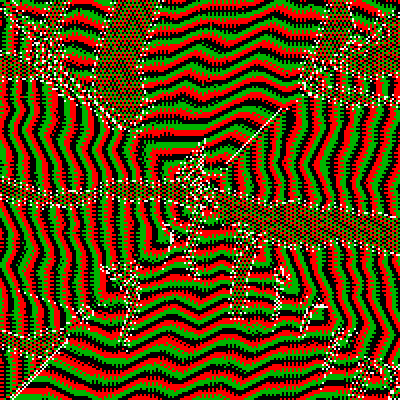
Hello there.
This is Numberphile. We mainly post videos about mathematics and just numbers in general.

This is Numberphile. We mainly post videos about mathematics and just numbers in general.
This Numberphile video about red and black knights (and more so it’s accompanying Numberphile2 video) resulted in some astounding patterns and images.
I recommend viewing them both for full context before scrolling further.
I have since received many emails from people who have delved further and created their own images and simulators, etc.
It’s impossible to list them all, but I have collated some here. Sorry if I missed you out, this selection is quite random. But I did look at every email…
Most messages have been edited and truncated… and I cannot vouch for any of the links.
Chris B:
I have made a web version of the tool; the source code is still at the github link if you're interested to read it, but if you just want to play around with the visualisation then you can access that here: 3D Knight Tool. It's still a work in progress so you'll have to forgive the occasional bug/glitch. Once you've seen all the pre-defined scenes that I came up with, the most interesting thing to do is to open the "edit leapers & scenes" dialog and change some of the parameters in there - the "leapers" box defines each of the pieces, which are then referenced in the "scenes" box - it should be mostly intuitive but I'm happy to answer any questions you have about how the interface works.
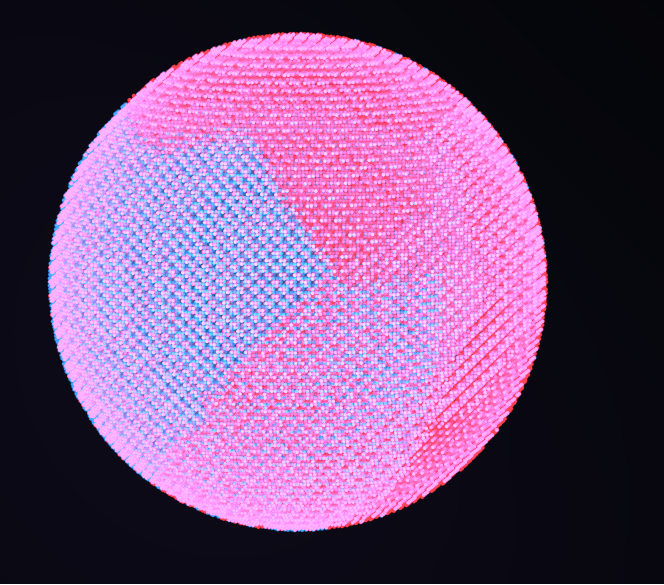
Here is what the ball looks like with two traditional knights of two colours (one blue, one red) at radius 80:
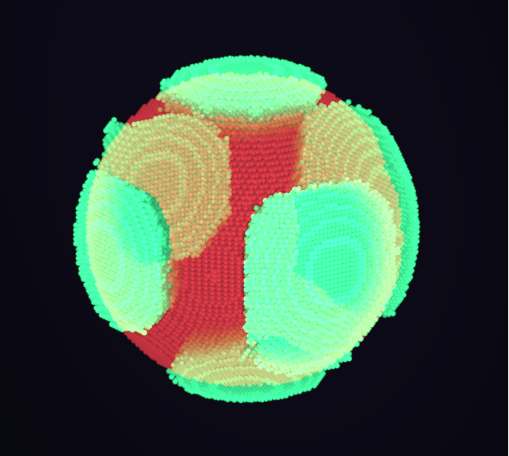
As an aside, I've just added a new piece that I'm calling a "spider", which moves in a (2, 1, 3) pattern - when paired with the wazir's (1, 0, 0), you get this pretty interesting looking ball (the "3D Spiders vs Wazir" scene from the tool):
Alekas R:
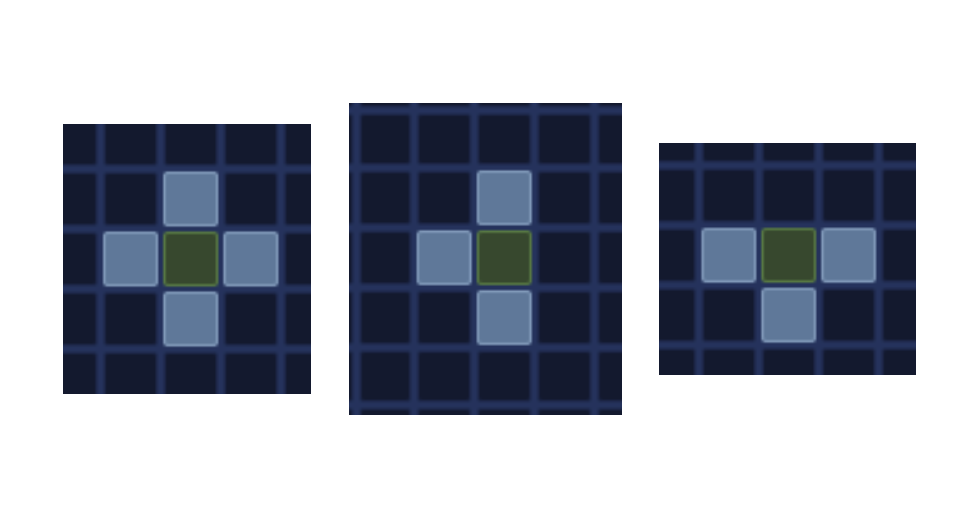
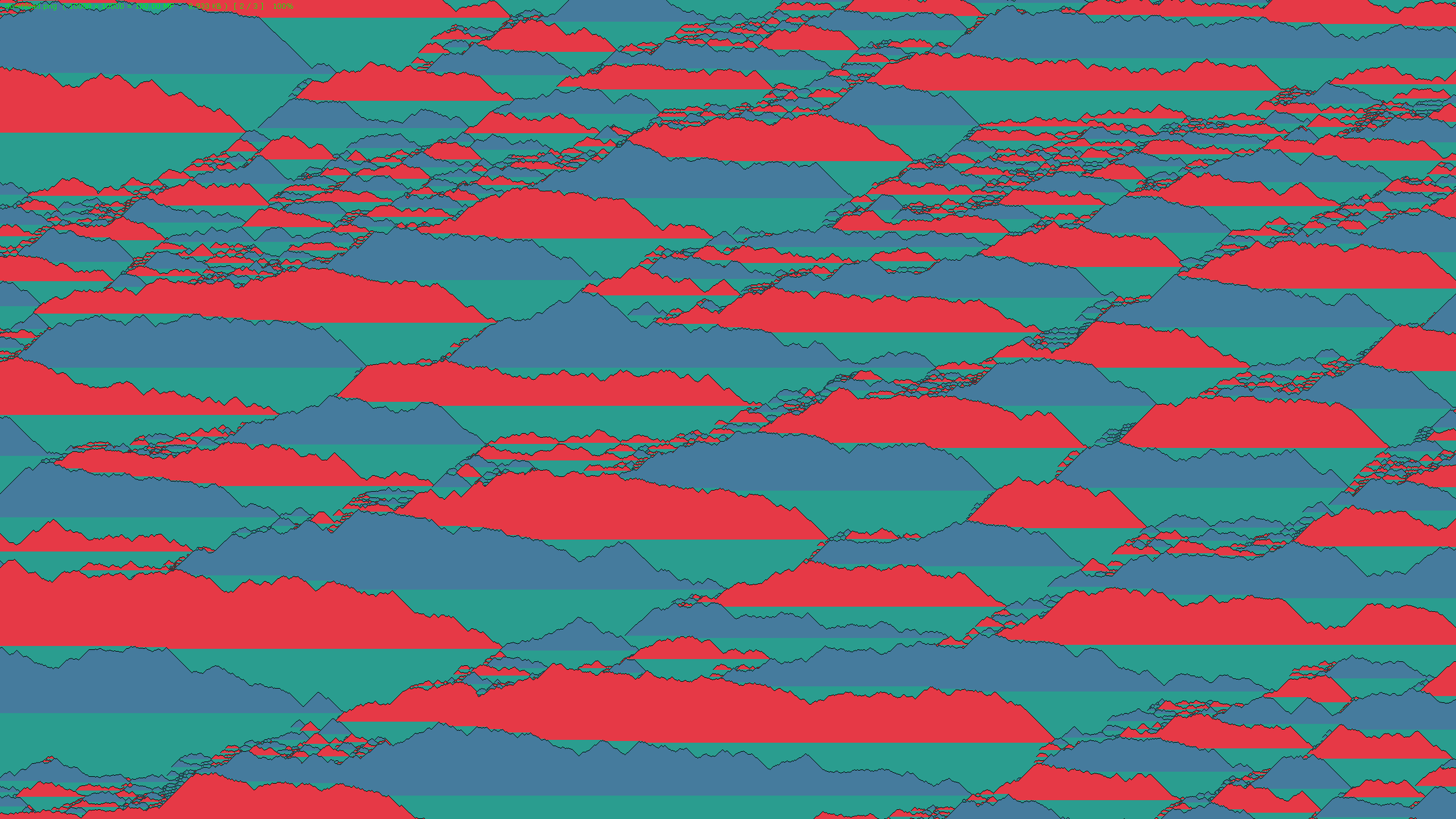
Watched your recent numberphile video about different patterns that can arise from chess knights interacting on a spiralling board, and ended up finding a rather pretty pattern myself, so thought I'd share it with you. This one is not from real chess pieces, these being my three pieces possible movements:
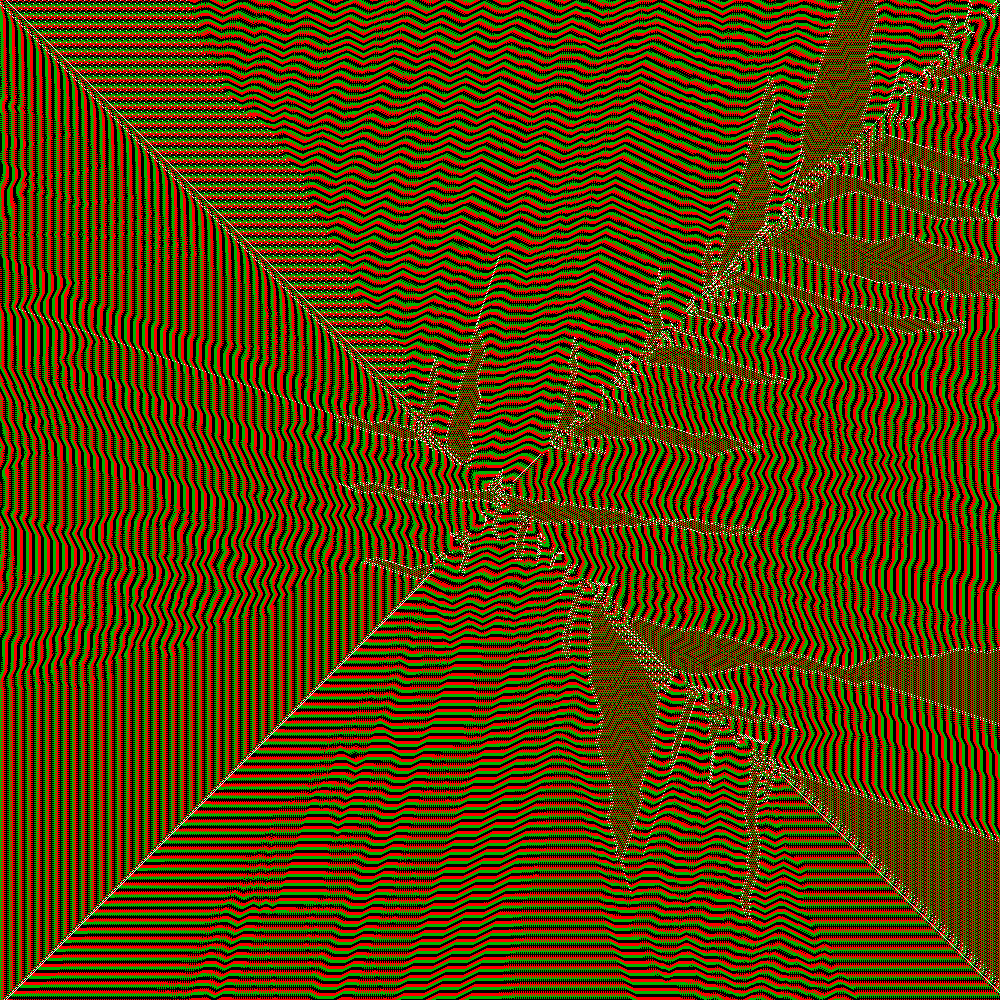
And this is the result:

Seems odd from afar, but when zooming in on the left quadrant it's a very quaint repeating mountain range:
Sean T:
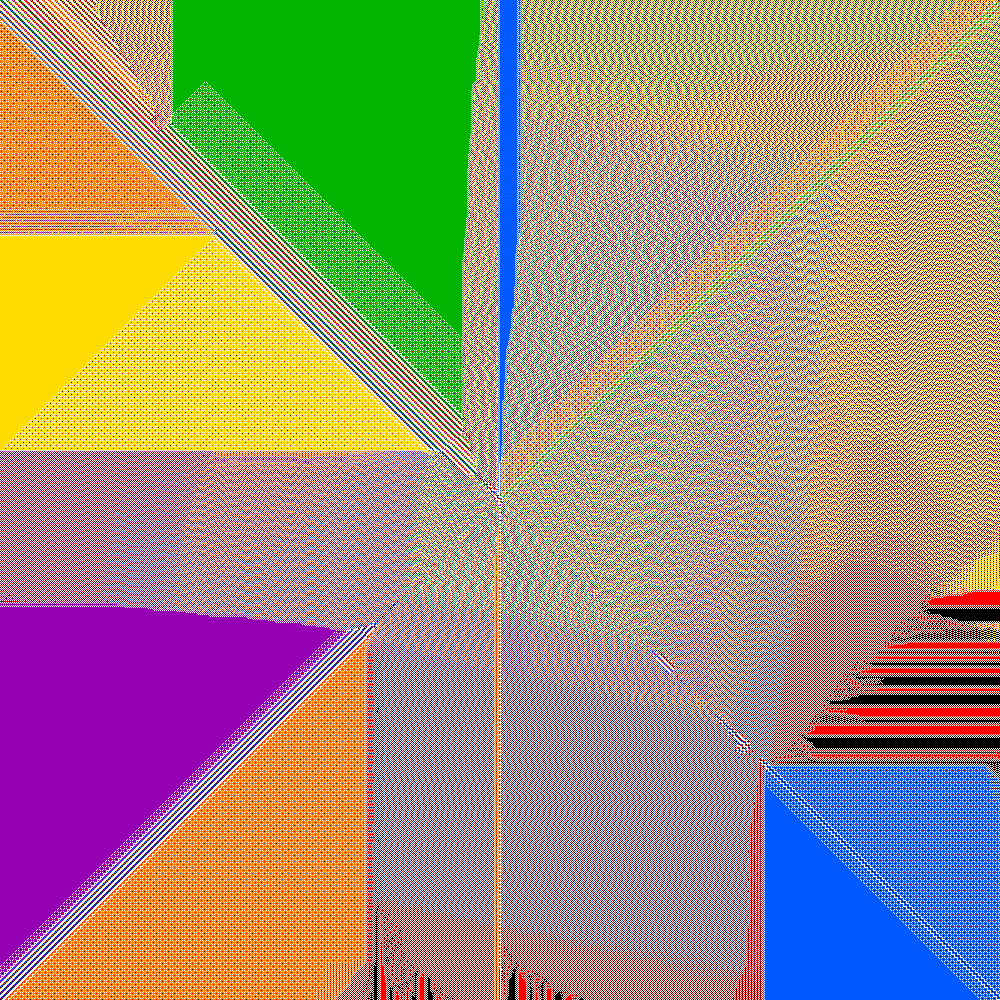
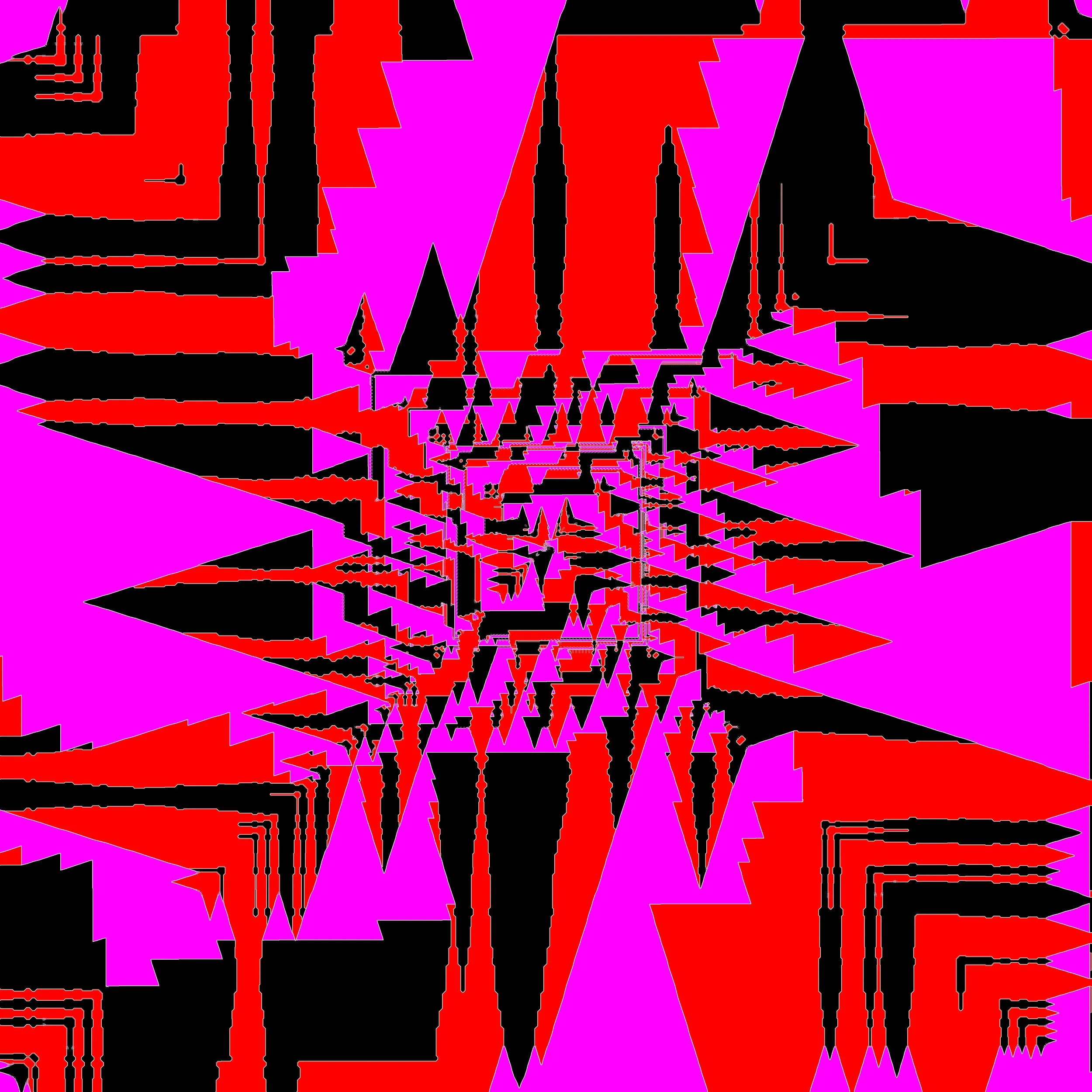
Well I know a little programming so along with AI I wanted to experiment and make my own program to calculate and generate these images of different piece combinations. So I guess my reasoning for the email today is 2 parts. First I was wondering if you could test a couple piece combinations that give interesting results for me and 2 if you'd like the program you can use it yourself. It's a standalone .exe with a settings.txt which allows you to set the pieces and colors it uses. The pieces it uses allows you make completely new movement rules without messing with the code. Now it is setup to calculate these on my GPU so I can't guarantee it will be able to run on your GPU so at the very least can you try this combination of pieces please and verify it gives some interesting results. How I describe the movement rules is an array compressed down to a single line with each row being separated with a '/' so team 0 is 02020/20002/00100/20002/02020 which is a normal knight then team 1 is another normal knight 02020/20002/00100/20002/02020 and then team 4 is 2200022/2000002/0000000/0001000/0000000/2000002/2200022 which I made up.
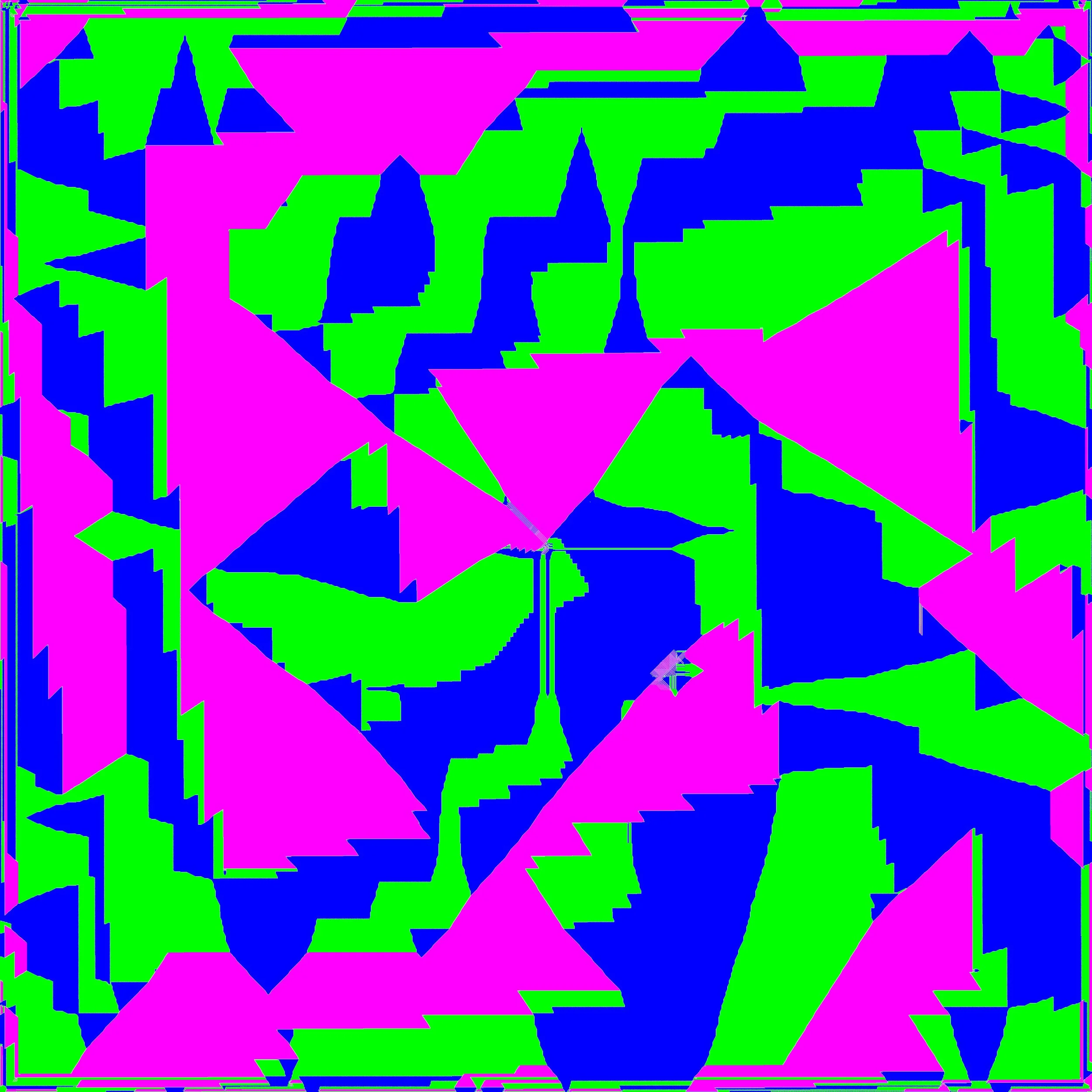
Then the other image is using teams 2, 3, and 4. team 2 is 020/212/020 just a single move up down left or right. team 3 is 202/010/202 just a single diagonal and finally team 4 is the same as the previous 2200022/2000002/0000000/0001000/0000000/2000002/2200022
Robert G:
Inspired by your recent video with Neil Sloane about patterns with chess pieces, I made a tool that lets you try out different configurations of pieces to see what they create.
https://rgambee.github.io/knight-grid/
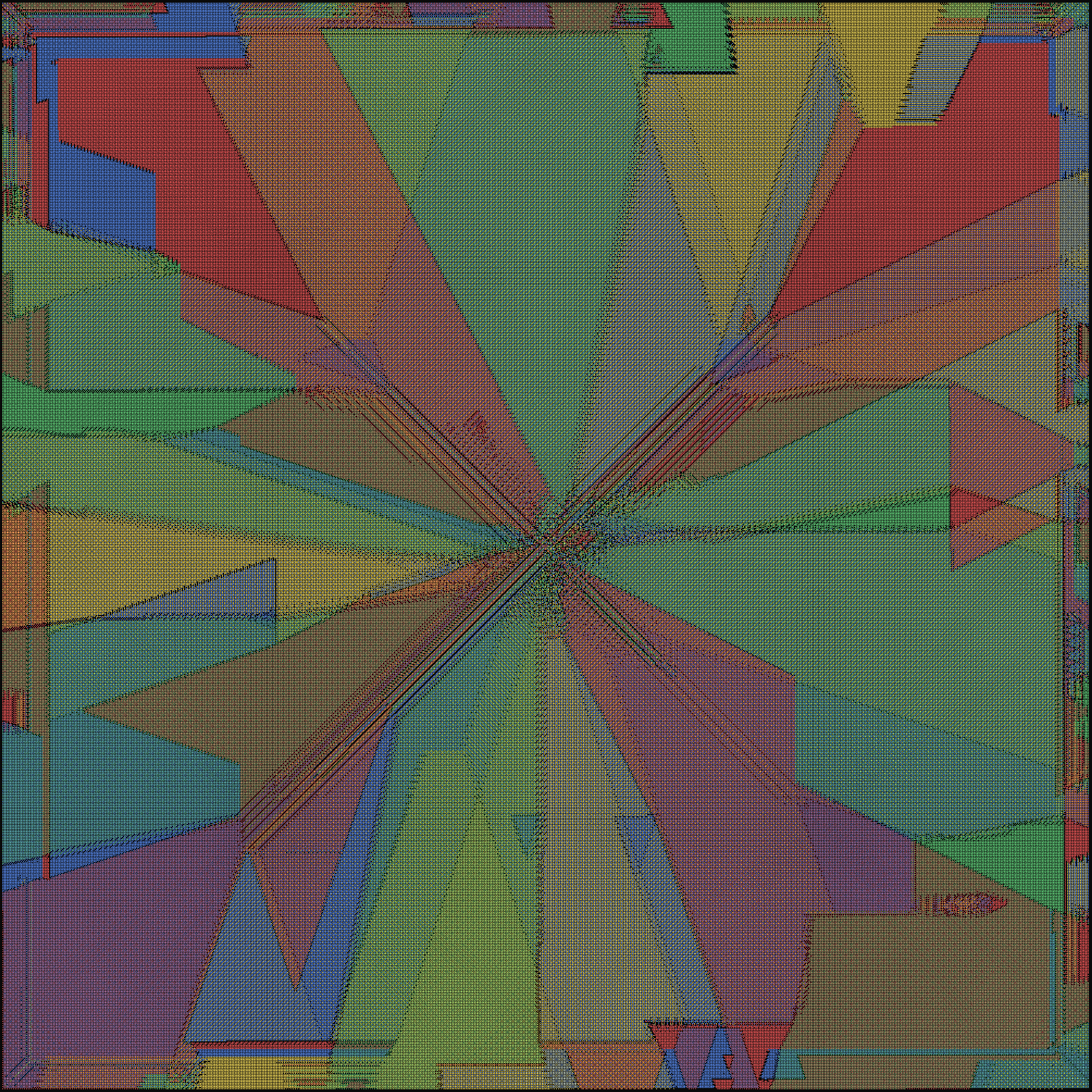
Feel free to play around with it and share it with others. You can click the share button to copy a link to your current configuration. Here's my favorite so far:
I've been watching Numberphile since it started and never miss a video. Your earlier video with Neil about the trapped knight is one of my all-time favorites. But this newer one is even better! Thank you so much for the fantastic content you produce across all your channels.
Christeana Z:
I watched the Red & Black Knights video with Neil Sloane and was struck by how a simple two-color placement rule eventually produces large red and black regions instead of staying visually random.
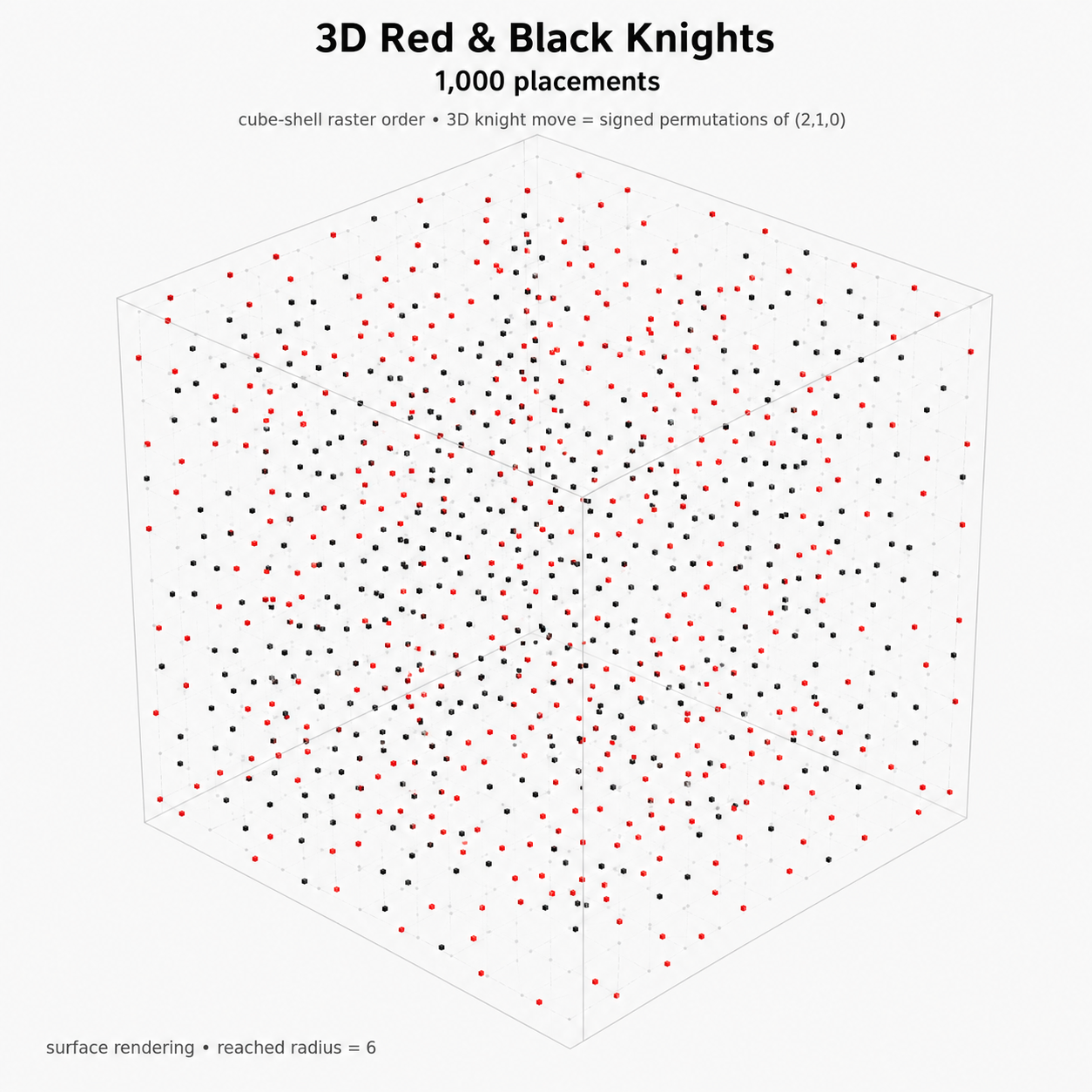
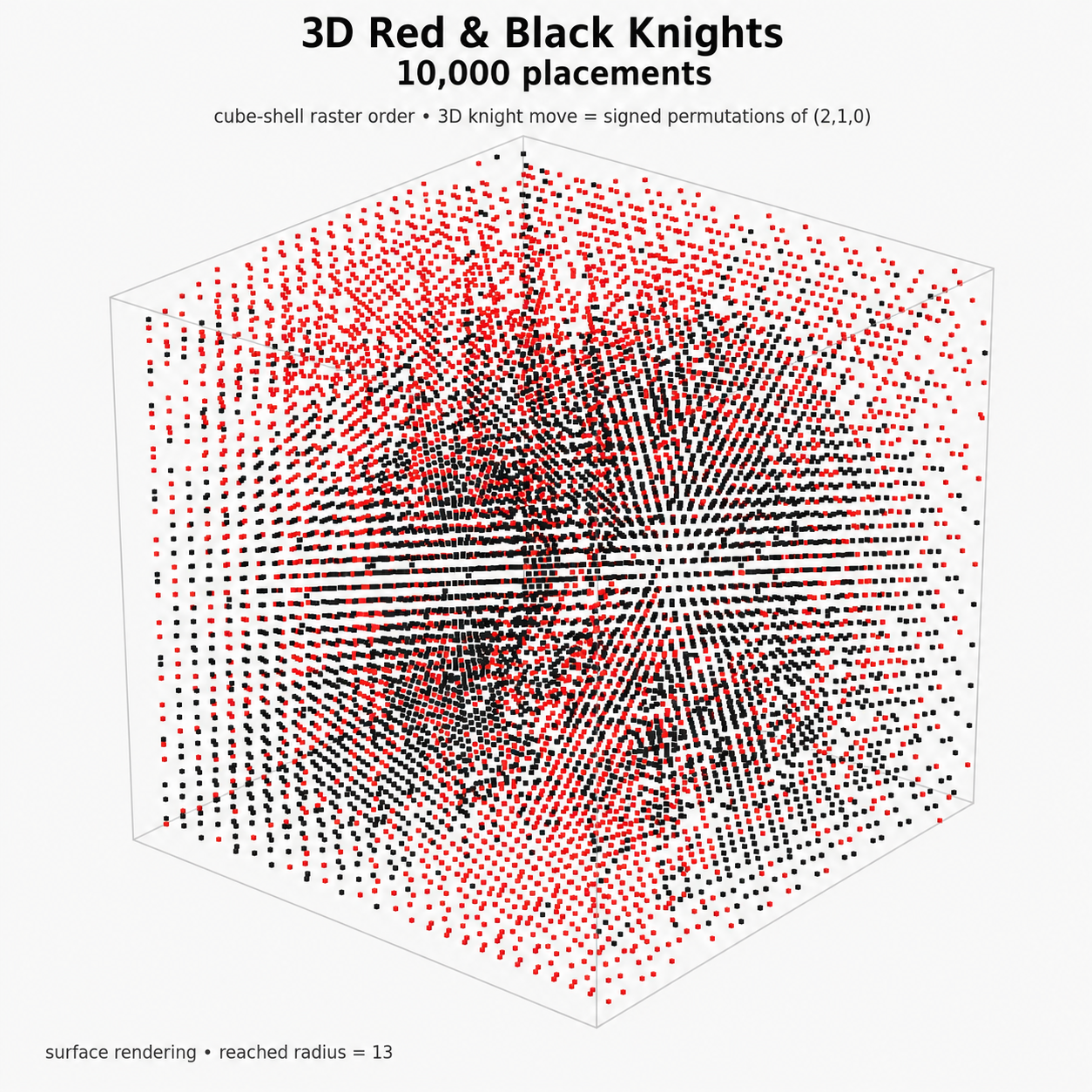
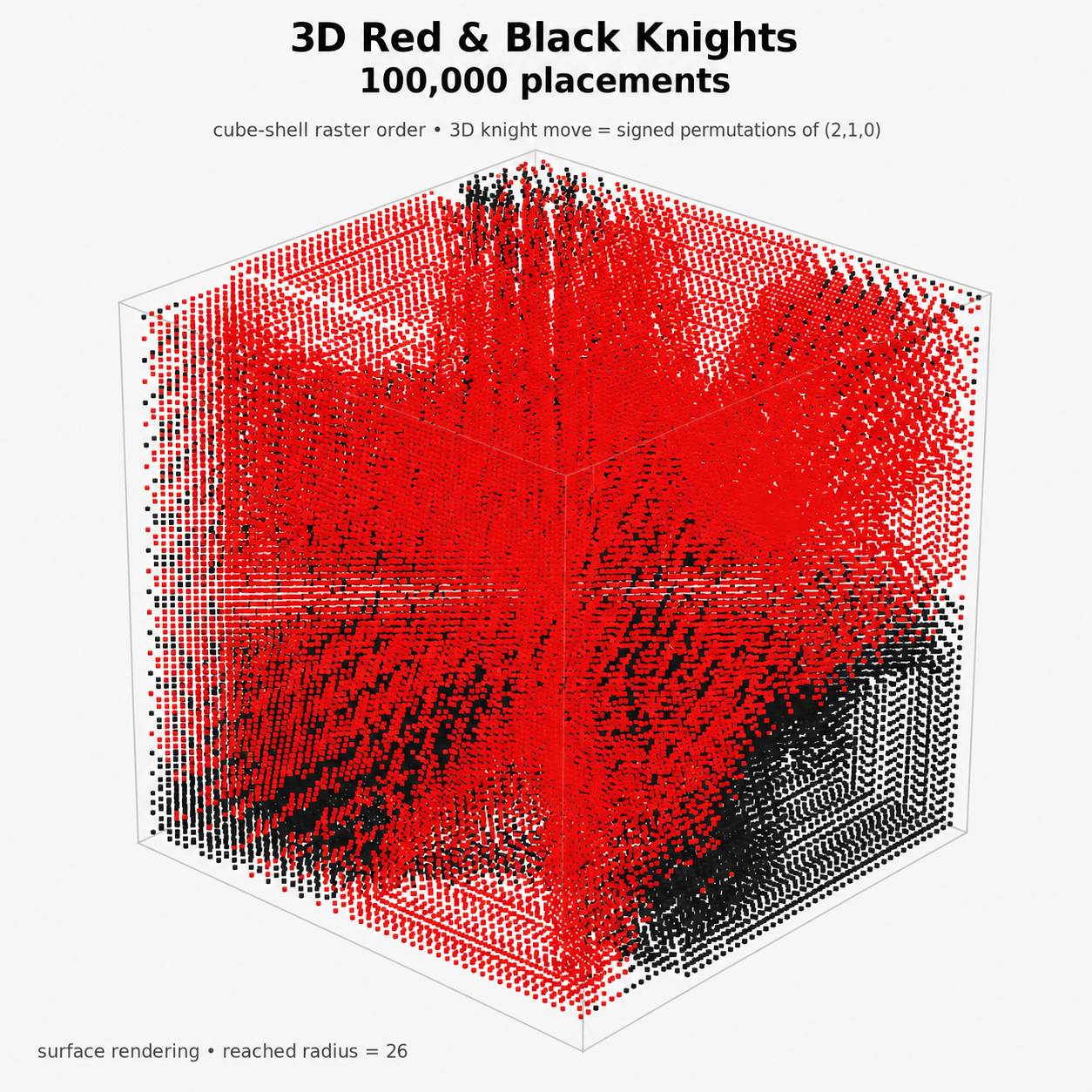
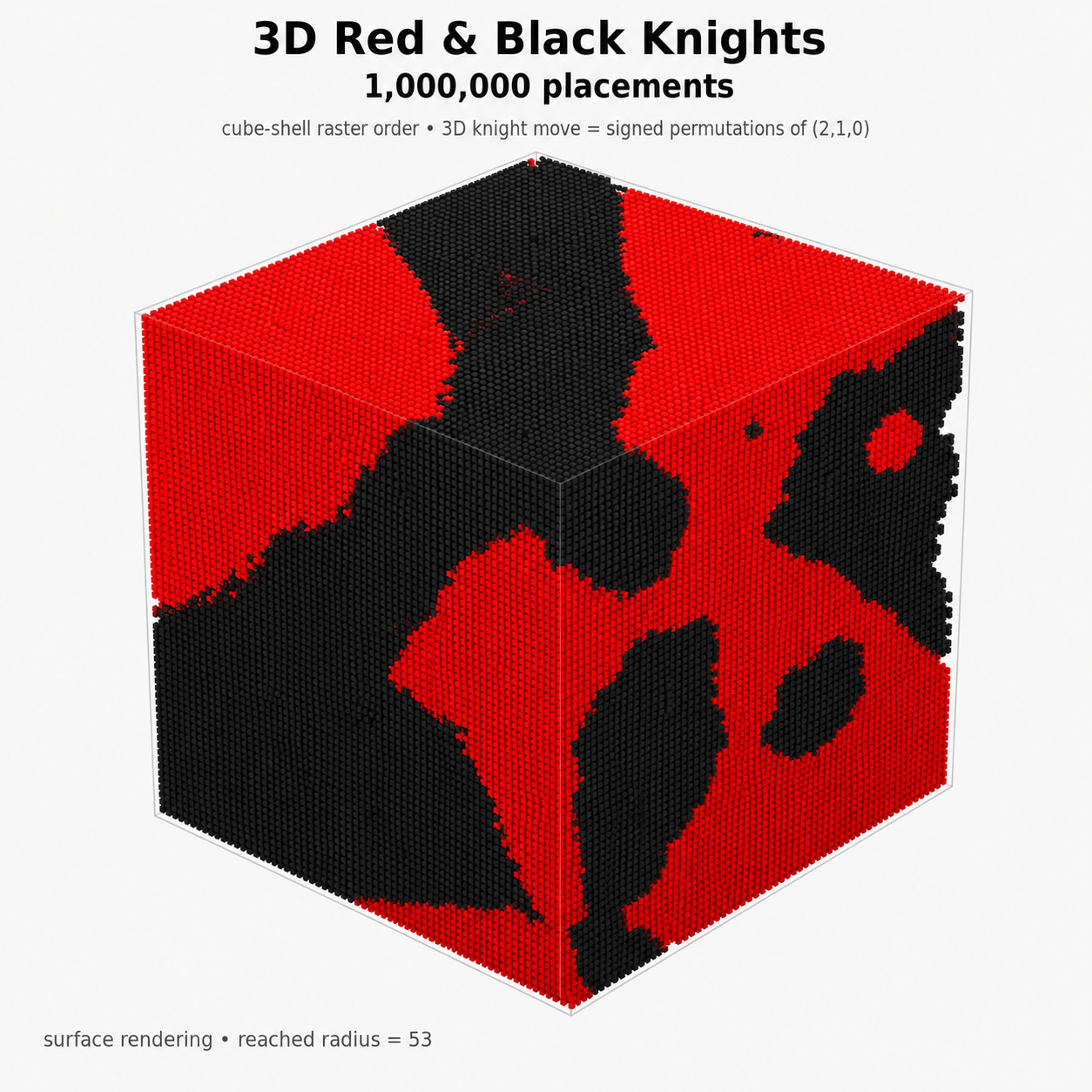
I tried a 3D version of the same idea on the integer lattice Z³. For the knight move, I used any signed permutation of (2,1,0), so a knight attacks 24 lattice points instead of 8. Since there is no canonical 3D square spiral, I used one explicit ordering: cube shells by Chebyshev radius, starting at (0,0,0), then scanning each shell in fixed raster order.
The rule I used was:
Black moves first.
Red and black alternate.
Each color chooses the earliest unoccupied lattice point not attacked by the opposite color.
Same-color attacks are allowed.
No occupied point can be reused.
I generated deterministic surface-rendered images at 1,000, 10,000, 100,000, and 1,000,000 total placements. The count checks passed at each interval. At 1,000,000 placements, there were exactly 500,000 red and 500,000 black knights, and the reached cube radius was 53 in this ordering.
The interesting part is that, at least for this ordering, the 3D surface views show large territorial domains. Instead of 2D strips and regions, the separation becomes volumetric, with red and black regions divided by sheet-like boundaries. I would not claim this is the unique 3D answer, since changing the 3D ordering could change the orientation or geometry. But it seems like a reproducible extension of the original rule and highlights a new issue: in 3D, the numbering order becomes part of the problem.
I attached the interval images.
Lars:
Since you posted the followup video of the Knight spiral showcasing additional "spinoffs" on the original interesting red-black pattern, I just had to make an interactive online version!
The reason for this email is that I wanted to show you the following Knight spiral website I created as a supplement to your video(s) on the subject.
https://halvorhansen.no/knightsandbox
I’m sure more people would be happy to use it, but I don’t think anyone would find the sandbox.
Ben W:
After making a program to generate images with various piece combinations.
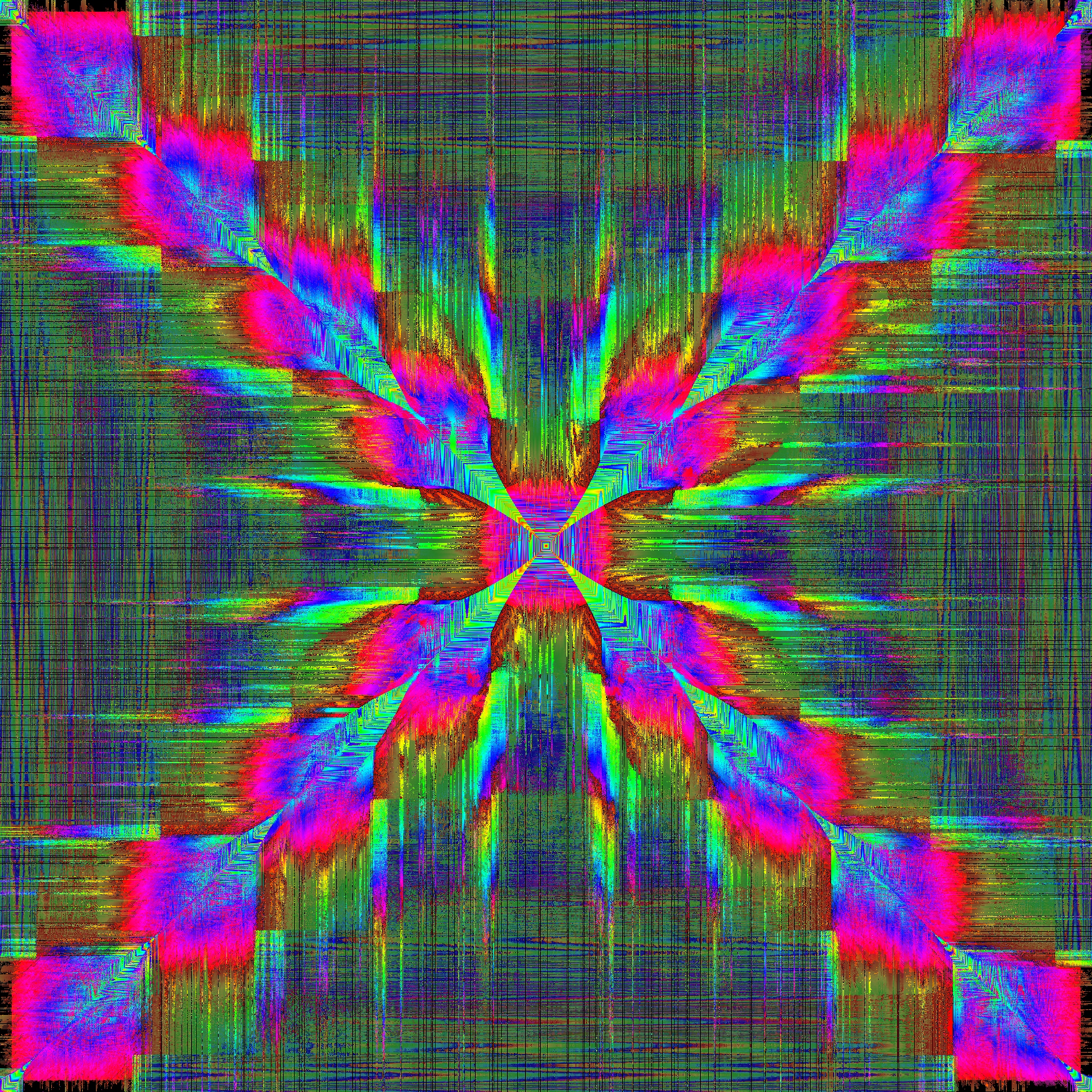
A favourite so far…
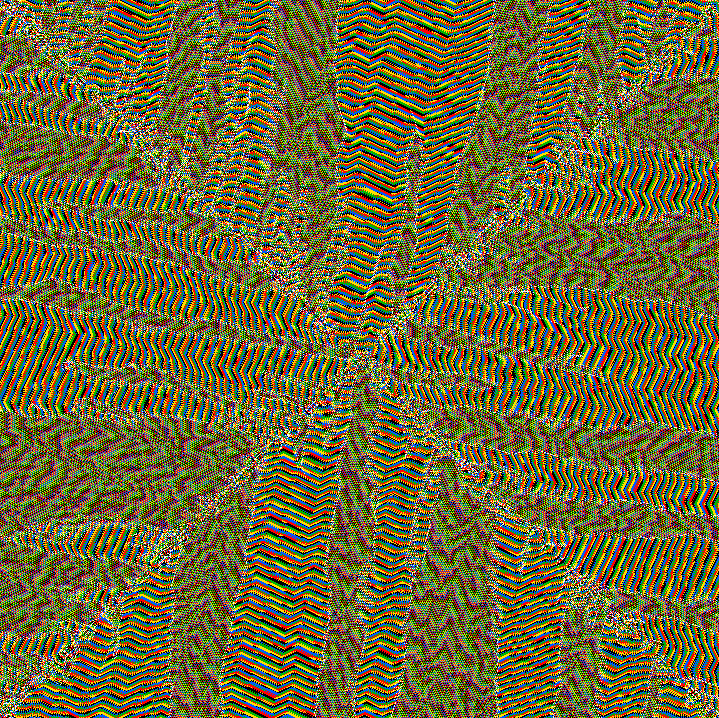
255 pieces - a knight-like piece that moves 1 square in one direction and n squares in the other direction, one for each n from 0 to 254:
Cameron C:
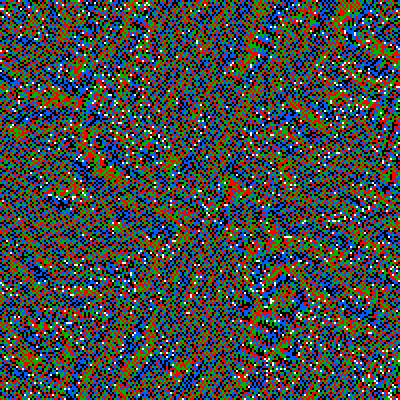
Your recent chessboard patterns Red and Black Knights videos were amazing! I've attached the 7 knights version I thought was particularly interesting.
I do have some more variants for you.
The simplest one is basically rock paper scissors. Rock knight can only be attacked by paper knight etc.
I've also done it for n-cycles types of knights, but we can also do it for any variant of dominance cycles you can think of (like rock paper scissors lizard spock)
Attached you'll also find a gallery of some of my favourite variants I stumbled across, including self-blocking, probabilistic blocking and time-varying blocking.